
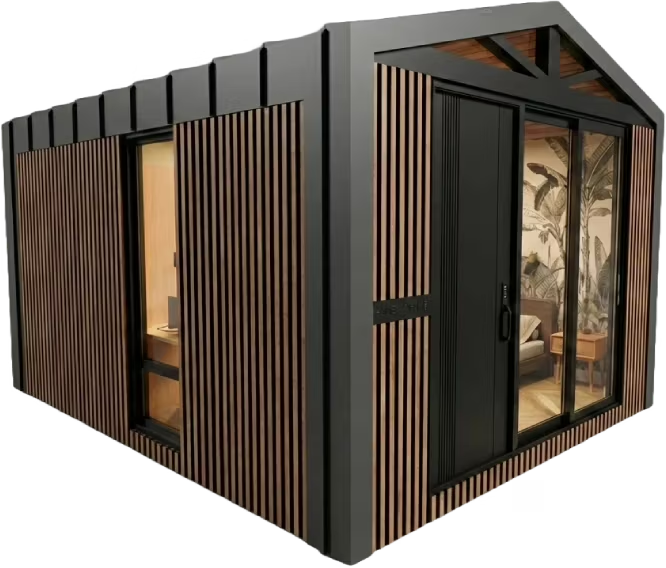
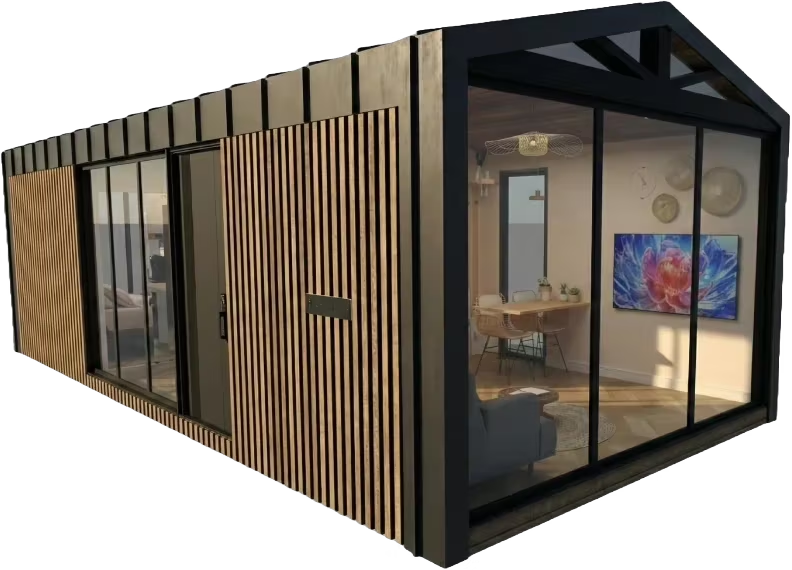
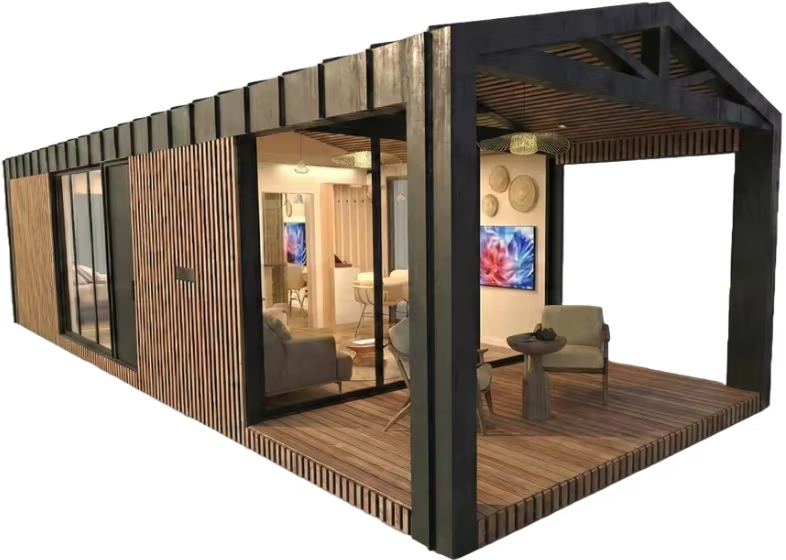
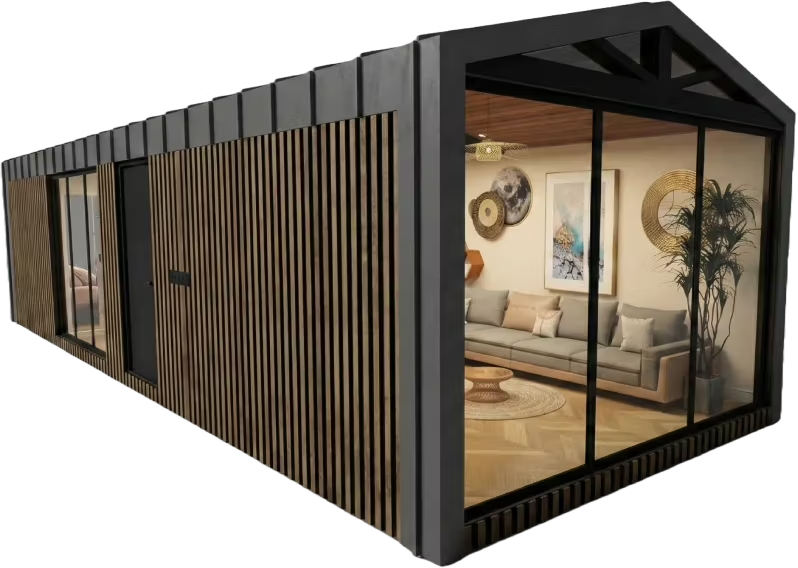
“Cyclone-proof house Guadeloupe” comes up in thousands of searches every year, and the question behind it never changes: will it hold? No brand can answer that in place of the texts that already exist — calculation standards, zoning rules, the CSTB's public guide. This dossier starts from those texts, then explains what pile foundations actually change, without ever claiming a resistance no one is entitled to promise.
Feature · August 2026
Back to the blog

Projection — a Home Kit Home habitat delivered equipped, at the end of the day. No actual delivery is depicted.
The question isn't whether it will hold. It's who builds what, and under which rules.
I · The word A serious question, an answer that doesn't fit in a slogan
“Cyclone-proof home” is not a technical category. No regulation hands that label to a product: structures are calculated, sized and built to precise rules — a home is never simply “cyclone-proof” on its own.
The question that actually matters isn't finding the right label, but knowing which rules apply to the plot in question, and who answers for them once the habitat is in place. Home Kit Home sets out its range of habitats delivered equipped, see the habitats page, before getting into the detail of those rules.
II · The rules What the regulations set, before any brand
Guadeloupe and Martinique sit in a zone of high seismic risk and in a zone exposed to cyclonic winds — a regulatory classification that applies to the territory, not to a manufacturer. Two European standards govern the calculation of any building built there: Eurocode 8 (standard NF EN 1998) for earthquake resistance, Eurocode 1 (standard NF EN 1991-1-4) for wind actions.
This body of rules was recently completed by decree n° 2023-1087 of 23 November 2023 and by the order of 5 July 2024. The latter set a two-stage timetable: in force since 1 January 2025 for most of its provisions, it has applied only since 1 January 2026 to individual homes in importance category II — that is, to the house you are having built (article 11). These rules are new, and they are enforceable. Separately, the CSTB publishes a public guide — the C2PMI, on the design and construction of storm-resistant individual homes in the Antilles — a reference open to any buyer, whatever the product under consideration.
III · Installation Anchored on piles, not a slab poured on site
A Home Kit Home habitat arrives as a single finished block, with a galvanised steel structure. It isn't poured on the plot: it's set on piles and put in place by crane, over a few days, by local companies appointed by the client.
This method pours no concrete slab, digs no heavy groundwork, occupies no platform to pour — the footprint on the plot stays limited from the first day of installation to the last. What that actually changes depends on the ground and the site: it's up to the companies carrying out the anchoring to size it to the standards in force, plot by plot.
The structure and finishes of the SIGNATURE model, installed this way, are set out on its dedicated model page.
A study carried out on a real plot illustrates this method — the Petit-Bourg project, in projection, where pile foundations are precisely what makes the plot buildable without heavy groundwork.
This dossier stops at the climatic and seismic risk; the full timeline, from order to handover, is set out in our dossier on construction time.
It isn't the brand that answers for the ground beneath the home. It's the company that anchors it.
IV · Responsibilities The module changes hands. The anchoring stays local.
Home Kit Home sells the module and its delivery to the plot; everything else belongs to the client. Pile anchoring, foundation sizing and their compliance with seismic and cyclonic construction standards are contracted and paid for directly by the client, with local companies — Home Kit Home can present and estimate these for guidance, but never contracts or invoices them.
The companies carrying out the anchoring carry their own insurance. It's them, not the module's supplier, who answer for the ground holding beneath the home, plot by plot.
V · What we don't say No rating, no promise: what the study says, stated plainly
Home Kit Home makes no cyclonic or seismic certification claim for its habitats, and announces no resistance rating. What the company can state are the facts set out above: a galvanised steel structure, pile foundations with nothing poured on site, and anchoring work entrusted to local companies, under the standards in force on each plot.
The Petit-Bourg plot has since been sold, and its study remains published as a technical reference — talking it through with Home Kit Home is how to get, plot by plot, what the standards require before signing.
Frequently asked questions
Does a Home Kit Home habitat withstand cyclones?
Home Kit Home never uses that kind of claim: a structure's resistance can't be deduced from a brand, it's calculated plot by plot under the standards in force (Eurocode 8, Eurocode 1). What can be checked are the facts of the product — a galvanised steel structure, piles with nothing poured on site — and the fact that ground anchoring is carried out and insured by local companies appointed by the client.
Which rules apply to building in the Antilles?
The Antilles are classified as a zone of high seismic risk and a zone exposed to cyclonic winds. Eurocode 8 governs seismic calculation, Eurocode 1 governs wind actions; decree n° 2023-1087 of 23 November 2023 and the order of 5 July 2024 add to this body of rules, and the CSTB publishes a public reference guide, the C2PMI, dedicated to individual homes in the Antilles.
Who installs the piles and the ground anchoring?
Home Kit Home sells the module and its delivery to the plot. Pile anchoring and foundations are carried out by local companies, contracted and paid for directly by the client, who carry their own insurance.