
Nearly everything written about pile foundation construction in the Antilles talks about the anchor itself — the installation, the soil, the bearing capacity. None of it says what comes to rest on it once the pile is in place. This dossier starts there: why a pile foundation pours no slab, what that changes on clay soil, on a slope or in a seismic zone, and what it means when what arrives on top is an already finished habitat.
Feature · September 2026
Back to the blog

Module being lifted above its piles — illustration of the method. The anchoring is carried out beforehand by local companies; no actual delivery is depicted.
No slab poured. The ground stays as it is. The habitat comes to rest on it.
I · The ground The ground decides. The choice of foundation comes after.
In the Antilles, the ground that receives a habitat is never neutral: clay and shifting in places, sloped elsewhere, and across the whole territory, in a seismic zone. Three conditions, the same question every time: how far down do you need to go to find stable support, and how do you reach it without disturbing the plot?
Clay soil swells or settles depending on its moisture; a foundation resting on that surface layer alone follows its movements. None of this is settled in the abstract: the answer depends on a soil survey, carried out by the company doing the anchoring.
On a sloped plot, everything hinges on levelling: does the ground need flattening before building, or can the structure follow its relief? In a seismic zone, it's the calculation rules that apply to any building on the territory that take over — a subject covered in detail in our dossier on climatic and seismic risk in the Antilles. Here, we stay with the ground and the support.
II · To pour What a slab requires, whatever the ground.
Pouring a concrete foundation generally follows a similar sequence: excavating part of the ground, building formwork, laying reinforcement, then pouring the concrete and waiting for it to cure — its characteristic strength is conventionally measured at 28 days (fc28, under the NF EN 206 standard and Eurocode 2, the European standard for concrete structural design) — before building on it. The detail varies by foundation type — raft, ground-bearing slab, footings — and by the ground, but these steps belong to the same family, from one site to the next.
On clay soil or a slope, that sequence gets heavier still: the ground first has to be stabilised or levelled before the first formwork even goes up. The site opens earlier, and it stays open longer.
III · The pile A point support, not a whole surface.
A screwed metal pile works on a different logic: instead of spreading the weight of the building across a whole poured surface, it screws into the ground and concentrates the support at a few points, carried down to a load-bearing layer. For this type of pile, the principle is mechanical, not chemical: nothing is poured, nothing has to cure — other pile anchoring methods, bored or concreted, follow a different logic.
On clay soil, the support reaches down to a layer more stable than the shifting surface. On a sloped plot, each support adjusts individually to the level of the ground: no need to level a whole platform before starting. The choice and sizing of each anchor point remain a matter of soil survey, plot by plot, carried out by the company appointed by the client.
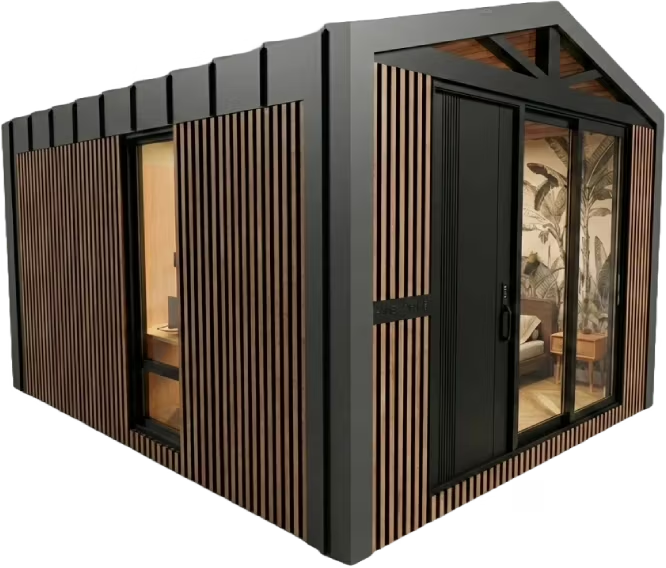
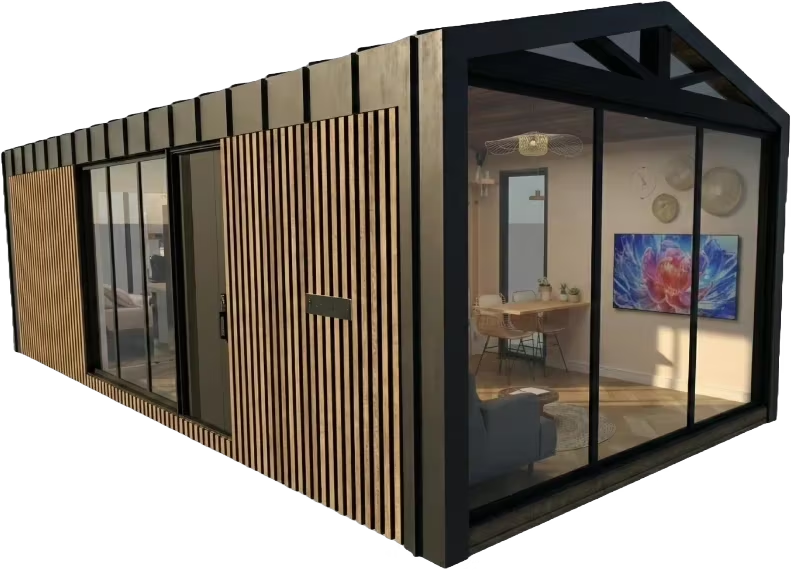
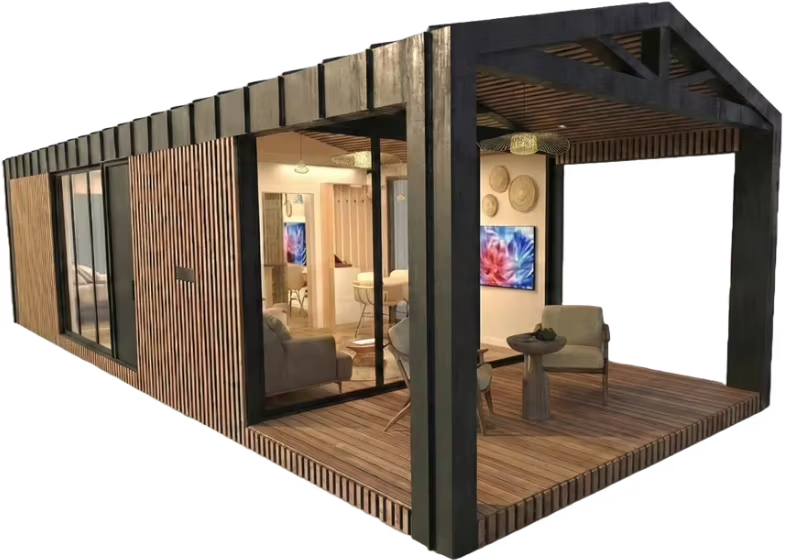
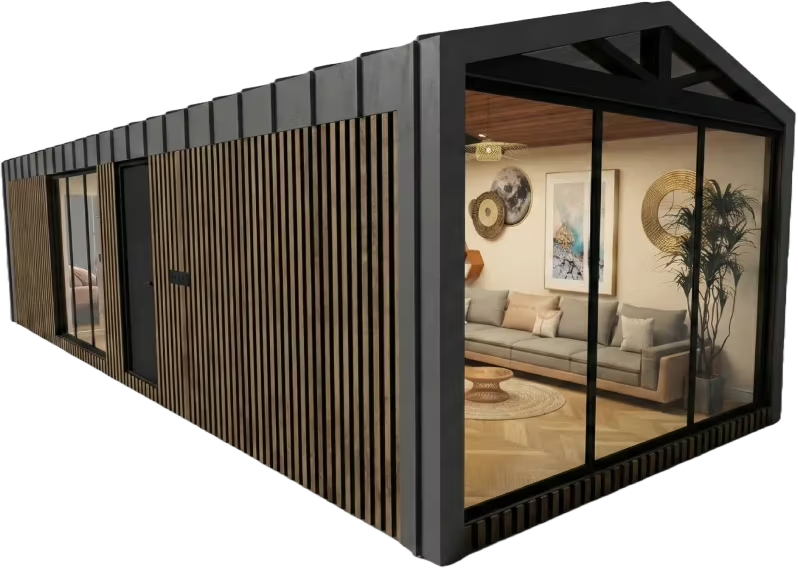
A Home Kit Home habitat arrives set in place this way — as a single block, on piles, put down by crane. The full range is available on the habitats page.
The pile answers for the ground. The habitat itself arrives already finished.
IV · The plot A slope that isn't corrected: it's followed.
A slope generally requires levelling the footprint before pouring a slab. In Petit-Bourg, Guadeloupe, a 778 m² plot has this kind of relief; the study carried out on that plot, is positioned on pile foundations.
Nothing in this dossier is signed: the plot has since been sold to a third party, and the study remains published as a technical reference.
V · Already finished What arrives once the support is in place.
A habitat set on piles is a finished module, built off site, whose load is carried to the ground through point supports anchored in depth — with no slab poured on site.
At Home Kit Home, this module arrives as a single block: galvanised steel structure, aluminium cladding under fluorocarbon paint, joinery, interior fit-out and finishes already completed in the workshop. The habitat ships delivered equipped; the anchoring, carried out beforehand by local companies, is already in place when the module comes to rest on it — what then arrives on the plot is no longer a building site, but a finished habitat.
VI · The boundary What Home Kit Home sells. What the plot contracts.
What Home Kit Home sells stops at the module and its transport to the plot; pile anchoring sits outside that scope. It's contracted and paid for directly by the client, with local companies, who handle the soil survey, the sizing and the installation. Home Kit Home can present and estimate this item for guidance, but never contracts or invoices it.
Each company appointed takes out its own cover; it is that company, not the module's supplier, that answers for the anchoring holding, plot by plot.
What ships with the module, and what stays for the client to arrange, is set out in our dossier on the inventory of a habitat delivered equipped.
Every plot has its own ground, and every ground its own answer: talking it through with Home Kit Home is how to move forward on this before signing.
Frequently asked questions
Why a habitat set on piles rather than on a slab?
A Home Kit Home habitat is set on piles, not poured on site: the support is a point support, carried down in depth, with no heavy excavation or platform to level. The choice and sizing of the anchoring rest with the local companies appointed by the client, based on a soil survey specific to each plot.
Does a habitat on piles hold up on clay soil?
Clay soil can shift with its moisture; how far down to go to find a stable layer always depends on a soil survey, carried out by the company installing the anchoring on the plot in question.
Can a habitat be set on a sloped plot?
A poured slab generally requires levelling a platform; independent supports can each adjust to the level of the ground without that groundwork. A study carried out in Petit-Bourg, Guadeloupe, presents this case on a real plot.
Who carries out the pile anchoring for a Home Kit Home habitat?
The module itself is sold and delivered by Home Kit Home to the plot; the pile anchoring is entrusted to local companies, chosen and paid directly by the client, who take out their own cover.